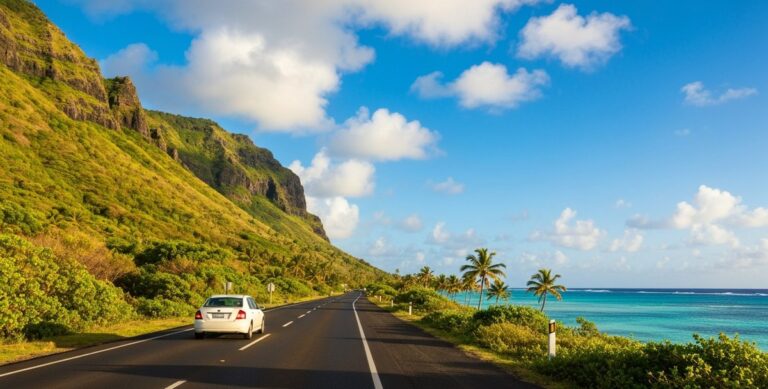
For most visitors to Mauritius, a taxi or private driver is the better default choice — especially for airport transfers, resort-to-resort travel, and one-off day trips. Renting a car makes sense if you plan to explore independently across multiple days and are comfortable driving on the left on narrow, unmarked rural roads.
Table of Contents
- The core question: what are you actually trying to do?
- How taxis work in Mauritius
- How car hire works in Mauritius
- Cost comparison: taxi vs rental car
- Driving in Mauritius: what you need to know
- When a taxi is clearly the better choice
- When renting a car makes sense
- Using mauritianrides.com: a middle path
- Practical tips whichever you choose
- FAQ
1. The Core Question: What Are You Actually Trying to Do?
Before comparing prices or reading reviews, it helps to be honest about your trip. Are you staying in one resort and making two or three day trips? Or are you renting a villa, bouncing between the north coast and the south, and eating at local restaurants that don’t appear on hotel menus?
The answer almost entirely determines whether a taxi or a rental car serves you better.
Mauritius is a small island — roughly 65 kilometres from north to south and 45 kilometres east to west — but those distances can feel deceptively long. Roads are narrow in the interior, signage disappears around Black River Gorges, and Grand Baie’s Friday evening traffic is something no sat-nav adequately prepares you for. At the same time, a flat-fee taxi from Flic-en-Flac to Port Louis costs somewhere between Rs 800 and Rs 1,200 and takes about 30 minutes. Neither option is obviously superior; they suit different travellers.
2. How Taxis Work in Mauritius
The official taxi system
Mauritius has two categories of licensed taxis: individual taxis (smaller vehicles, usually saloon cars) and tourist taxis (often larger, air-conditioned vehicles specifically licensed for tourist routes). Both operate legally under the National Transport Authority.
Unlike Uber, there is no meter law universally enforced across the island. Most fares are negotiated before you get in, which can feel uncomfortable if you are unfamiliar with going rates. Drivers at the airport arrivals hall, outside hotels, and at major attractions will quote you a price; whether that price is fair depends largely on how confidently you respond.
Pre-booked private drivers
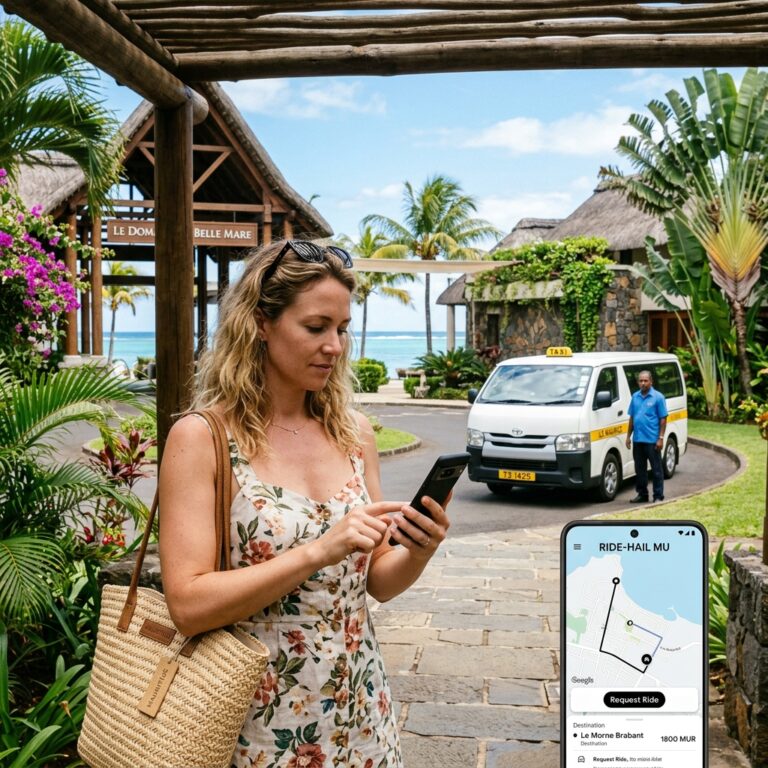
The alternative — and one that removes the negotiation entirely — is booking a driver in advance through a platform like mauritianrides.com. You agree the fare before travel, the driver arrives at the time you set, and there are no awkward roadside discussions about whether Rs 1,500 or Rs 2,000 is the right price to get from Mahébourg to Blue Bay. For airport arrivals in particular, this removes one of the most stressful parts of landing somewhere unfamiliar.
What taxis cannot do well
Taxis are less convenient if you want the freedom to stop spontaneously — to pull over at a roadside stand selling pineapple, to double back to a viewpoint you passed, or to stay somewhere longer than planned. A hired driver on a day-trip basis can accommodate this, but it will cost more than a simple point-to-point transfer. A rental car gives you that freedom cheaply once the daily hire rate is sunk.
3. How Car Hire Works in Mauritius
Rental companies and vehicle types
International brands (Hertz, Europcar, Sixt) operate at SSR International Airport and in the main towns, alongside a large number of local operators. Local operators are often significantly cheaper — Rs 1,200 to Rs 1,800 per day for a small automatic, versus Rs 2,000 to Rs 3,500 from international companies — but the insurance terms, vehicle condition, and breakdown support can vary considerably. Always read the excess liability clause before signing.
Most visitors opt for a small hatchback or compact SUV. The compact SUV is worth the modest price premium if you plan to visit the interior — roads around Chamarel and the Black River Gorges can be steep and potholed, and the extra ground clearance reduces anxiety even if it is rarely strictly necessary.
What you need to hire
To rent a car in Mauritius you will need:
- A full, valid driving licence from your home country (minimum one year of driving experience is typically required)
- Your passport
- A credit card for the security deposit (debit cards are not accepted by most operators)
- Proof of accommodation
An International Driving Permit is not legally required for most nationalities, but some local rental companies may ask for one. Check in advance if you are not from the UK, EU, Australia, or South Africa, where reciprocal arrangements are broadly accepted.
Insurance
Third-party insurance is mandatory and included in all hire rates. Collision damage waiver (CDW) reduces your excess but does not cover tyres, windscreens, or the undercarriage — all of which are exposed to Mauritian road hazards. Standalone travel insurance with car hire excess cover is often the most cost-effective route.
4. Cost Comparison: Taxi vs Rental Car
Costs depend heavily on how you travel. This comparison assumes a couple staying for seven nights, doing a moderate amount of exploring.
| Journey / Scenario | Taxi / Pre-booked Driver | Rental Car (incl. petrol) |
|---|---|---|
| Airport (SSR) to Grand Baie | Rs 1,500–Rs 2,000 | Rs 200–Rs 300 petrol only (if car already hired) |
| Day trip: Port Louis market | Rs 1,800–Rs 2,500 return from north coast | Rs 150–Rs 200 petrol + parking |
| Day trip: Chamarel waterfall + Seven Coloured Earths | Rs 3,000–Rs 4,500 with driver | Rs 250–Rs 350 petrol |
| Airport transfer home | Rs 1,500–Rs 2,000 | Drop-off fee if returning at airport: Rs 500–Rs 1,500 extra |
| Full day hire (driver for 8 hrs) | Rs 5,000–Rs 8,000 | Rs 1,500–Rs 2,500 hire + petrol |
For a week of moderate exploration with three or four day trips, a couple might spend Rs 20,000–Rs 35,000 on taxis and pre-booked transfers. A rental car for seven days from a reputable local operator might cost Rs 10,000–Rs 18,000 in hire fees plus petrol — potentially cheaper, but the saving narrows when you add airport drop-off fees, parking in Port Louis, and the occasional taxi anyway (you still need to get back from the beach bar).
The financial case for renting a car is strongest when you plan to move frequently, stay in a self-catering property away from a resort, and are comfortable not drinking at dinner.
5. Driving in Mauritius: What You Need to Know
Left-hand traffic
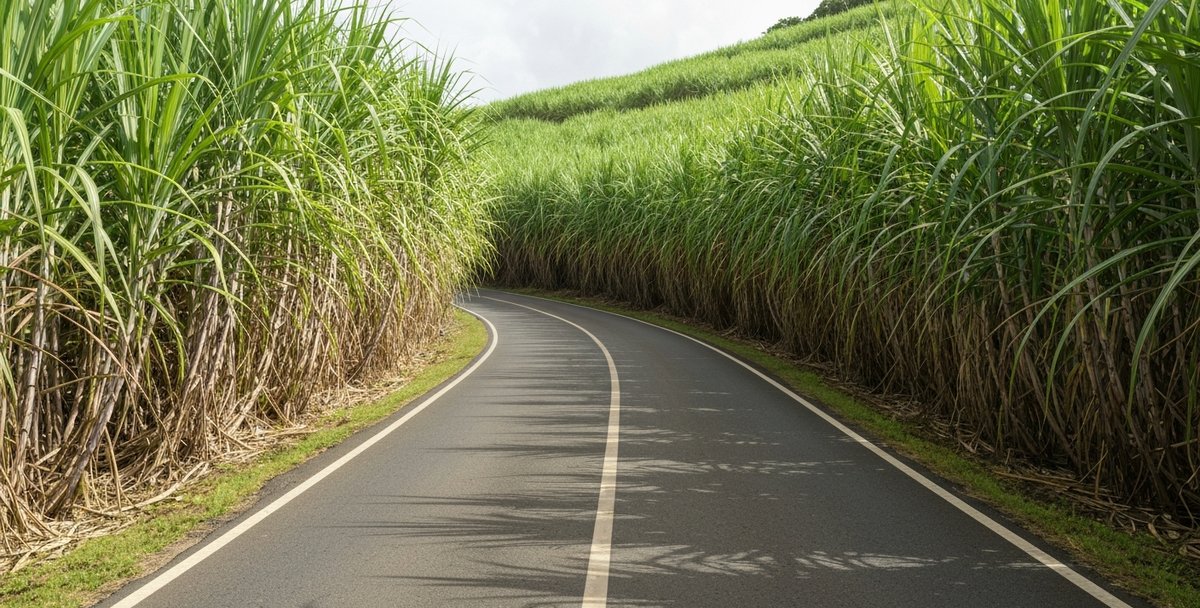
Mauritius drives on the left — the same as the UK, Australia, India, and South Africa. If you come from a right-hand-traffic country, this requires genuine adjustment, and the adjustment is hardest at quiet junctions when instinct pulls you to the wrong side.
Road conditions
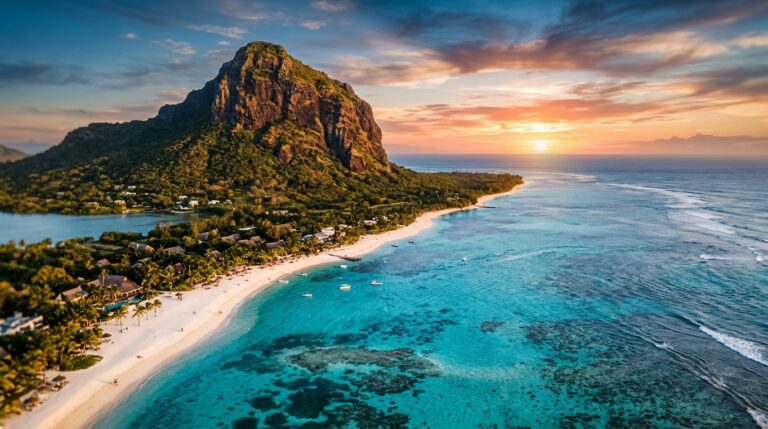
Main roads between major towns — the M1 motorway connecting the north to Mahébourg in the south, the A1 through the centre — are well-surfaced and straightforward. Secondary roads are a different matter. The road down to Le Morne from the main coast road is manageable. The back roads through Rivière Noire or east of Mahébourg toward Ile aux Aigrettes can be narrow, bumpy, and poorly lit at night.
Potholes are a genuine issue after heavy rain, particularly between July and September.
Signage
Signage in Mauritius is inconsistent. Town names appear at major roundabouts but can disappear entirely on rural roads. A reliable offline maps app (Maps.me with downloaded Mauritius data, or Google Maps with offline caching) is not optional — it is essential if you are driving independently.
Parking
Port Louis has multi-storey car parks near the Caudan Waterfront and a busy street parking system that can be confusing. Grand Baie and Flic-en-Flac have informal parking near the beach, usually free. Driving to Port Louis on a weekday morning and parking there is genuinely stressful; for city visits, a taxi or pre-booked driver is almost always the more sensible choice.
Drinking and driving
The legal blood alcohol limit in Mauritius is 0.05% — lower than the UK’s 0.08%. Practically speaking, if you plan to have wine at dinner, you should not be driving. This is one of the real, practical arguments for taxis: Mauritius has excellent restaurants, several of which are in areas with no practical alternative transport home.
6. When a Taxi (or Pre-Booked Driver) Is Clearly the Better Choice
Airport arrivals
Arriving at SSR International Airport in Mahébourg after a long-haul flight and negotiating a taxi fare at the kerb is not the ideal introduction to Mauritius. Pre-booking with a service like mauritianrides.com means a named driver is waiting in arrivals, the price is agreed, and you are in an air-conditioned car within minutes. This alone — for most travellers — is worth the category.
Short stays and single resort bases
If you are staying for four nights in a beachfront hotel in Trou aux Biches, leaving the hotel for one or two guided excursions, and spending most of your time at the pool, renting a car is overkill. The hire fees, deposit, and airport return logistics add cost and friction for no real gain.
Evening dining and nightlife
Grand Baie’s restaurant strip, the seafront in Flic-en-Flac, and the bar scene in Tamarin are all better accessed by taxi if you intend to drink. A pre-booked return transfer removes the unreliability of trying to flag a taxi at 11 pm on a Saturday.
Travel with luggage
Getting from the airport to a hotel with large suitcases and car seats (if you have young children) is much simpler in a pre-arranged vehicle than in a small rental car you are navigating unfamiliar roads with for the first time.
Day trips without driving stress
A hired driver for a full day in Mauritius typically costs Rs 5,000–Rs 8,000 and often doubles as an informal guide. For a Chamarel circuit — Seven Coloured Earths, Chamarel Waterfall, Black River Gorges viewpoints, and possibly Le Morne — this is a genuinely good value option. The driver knows where to park, knows which viewpoint to visit at which time of day, and you are not reading a map.
7. When Renting a Car Makes More Sense
Longer stays with varied itineraries
If you are spending ten or more days in Mauritius, staying in two or three different locations, and want to explore freely, the economics and convenience shift toward renting. Rs 1,500 per day all-in for a small car is a flat cost that covers unlimited movement.
Self-catering accommodation outside resort areas
Many of the best-value guesthouses and Airbnb properties in Mauritius — in Mahébourg, around Rodrigues if you extend your trip, in the hills near Curepipe — are not on regular taxi routes and are inconvenient to access without a car.
Repeat visits to the same spots
If you love a particular beach and want to return to it every morning at your own pace, a rental car pays for itself in convenience within two or three days.
Travelling with a group
For a group of four or five people, the per-person cost of a rental car drops significantly compared to taxis. A minibus taxi for five people from SSR Airport to the north coast might cost Rs 4,000–Rs 5,500; a seven-seat hire car for the same journey costs the same in airport drop-off fees alone, but then covers the entire week.
8. Using mauritianrides.com: A Middle Path
One of the frustrations with the taxi-or-rental debate is that it presents a binary choice. In practice, many visitors to Mauritius end up doing both — renting a car for some days and booking transfers for specific journeys — and this is a perfectly sensible strategy.
mauritianrides.com is built around exactly this kind of flexible approach. You can book a single airport transfer, a one-way journey from your hotel to a restaurant in Tamarin, or a full day with a driver for a southern circuit including Le Morne and Baie du Cap. Everything is pre-priced, the drivers are verified, and you are not standing at the roadside hoping someone stops.
For travellers who are nervous about island driving but want occasional freedom, a hybrid approach — book your arrivals, departures, and evening dinners through mauritianrides.com; rent a car for two or three daytime exploration days — covers most of what Mauritius has to offer without the stress of driving every trip yourself.
9. Practical Tips Whichever You Choose
If you book a taxi or private driver:
- Always confirm the price before departure. If the driver quotes a price per person, clarify whether it is per person or per car.
- For airport pickups, share your flight number so the driver can track delays.
- Carry small change — Rs 100 and Rs 200 notes — as not all drivers carry change for Rs 1,000 or Rs 2,000 notes.
- Pre-book through a platform like mauritianrides.com for transfers that matter: airport, evening returns, and long-distance journeys where being stranded is not acceptable.
If you rent a car:
- Download an offline map before you land. Mobile data can be patchy in the interior and near Black River Gorges.
- Inspect the car thoroughly before accepting it and photograph every existing scratch or dent — the rental company’s damage record and your photos should match.
- Fill up when you see a petrol station rather than waiting to find one. Rural areas can have long gaps between stations.
- Avoid driving into Port Louis on weekday mornings if you can. Traffic on the A9 from the north and the A1 from the south can add 45 minutes to a straightforward journey.
- Park in designated car parks when in towns — informal street parking in Quatre Bornes or Rose Hill can result in a fine or, worse, a vehicle that has been moved.
FAQ
Is it safe to rent a car and drive in Mauritius?
Yes, for the majority of drivers. Road conditions on main routes are good, traffic moves at manageable speeds, and the country is safe by any reasonable measure. The adjustment to left-hand traffic is the main challenge for visitors from continental Europe or North America. If you are unsure, spend your first day using a taxi and use that time to watch how traffic flows before deciding.
How much does a taxi from SSR Airport to Grand Baie cost?
Expect to pay somewhere between Rs 1,500 and Rs 2,000 for the roughly 55-kilometre journey from SSR International Airport in Mahébourg to Grand Baie in the north. The journey takes around 45 to 60 minutes depending on traffic. Pre-booking through mauritianrides.com gives you a fixed price before you arrive.
Do I need an International Driving Permit to hire a car in Mauritius?
Not for most nationalities. A full driving licence from the UK, Australia, EU countries, and many others is accepted directly. Some local rental operators may ask for an International Driving Permit regardless; if you are travelling from outside these regions, it is worth obtaining one before you travel to avoid complications.
What is the best option for a short break of four or five nights?
For a short stay, most visitors are better served by a combination of pre-booked transfers and occasional taxis. Unless you specifically want to explore independently and have experience driving on the left, the logistics of renting a car for four or five nights — including the airport return, the deposit, and the insurance paperwork — add friction without much corresponding benefit.
Can I take a taxi across the whole island for a day trip?
Yes, and this is one of the most enjoyable ways to see Mauritius. A full-day hire (typically 8 hours) with a driver covers a southern circuit or a northern tour comfortably. Agree the itinerary and price in advance. Rates typically fall between Rs 5,000 and Rs 8,000 for the day, and drivers often know the best times to visit each site.
Are rental cars available at SSR Airport?
Yes. All major international brands have desks in the arrivals hall, and several local operators have offices nearby with free shuttle transfers to their lots. Booking in advance online is strongly recommended during school holiday periods (French school holidays in particular drive significant tourist volumes) and between November and March.