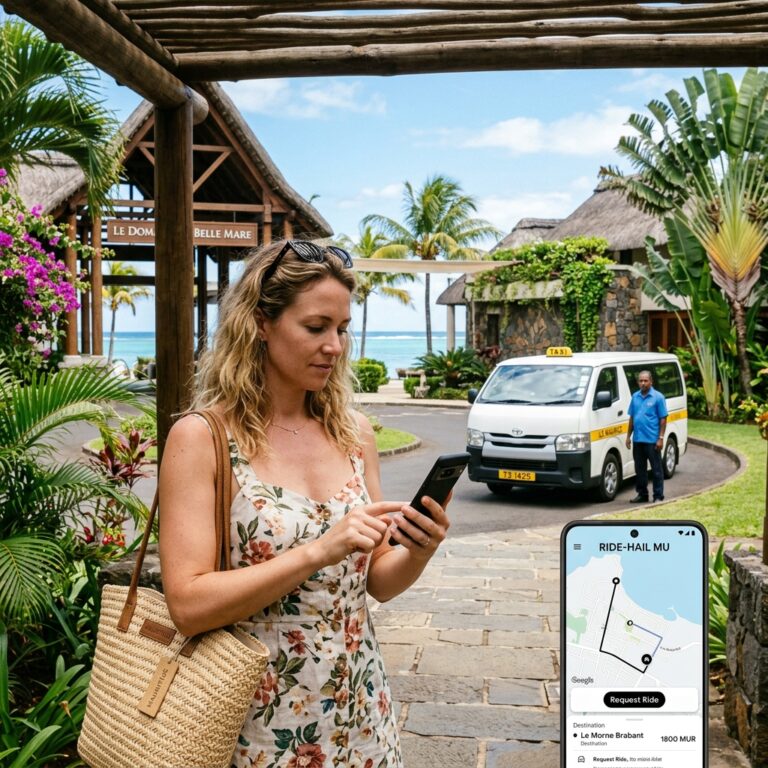
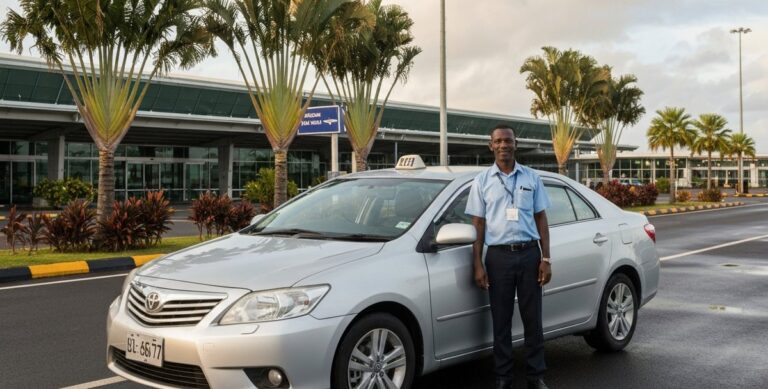
Getting around Mauritius is easier than most first-time visitors expect. The island is roughly 65 km long and 45 km wide, so no destination is more than two hours away. Your main choices are the public bus network, taxis, car hire, and pre-booked private transfers. Which option suits you depends on your budget, itinerary, and how much flexibility you want.
Table of Contents
- Why Transport Matters in Mauritius
- Public Buses — The Budget Option
- Taxis in Mauritius — What to Expect
- Car Hire in Mauritius
- Private Transfers and Ride-Booking
- Getting from the Airport
- Travelling Between the Main Regions
- Tips for Getting Around Safely at Night
- FAQ
Why Transport Matters in Mauritius
Mauritius has no rail network and no metro system. The entire island runs on roads, which means your transport choice shapes your holiday more than it would in a city with underground trains. Choose poorly — relying on buses for a tight itinerary, or paying tourist-rate taxis every day — and you will spend far more time and money than necessary.
The good news is that by 2026 the options are genuinely solid. The bus network covers most of the island cheaply, car hire is competitive, and services like Mauritian Rides make it possible to pre-book a verified private driver online rather than negotiating on the street. Understanding all four modes before you arrive will save you both stress and rupees.
Public Buses — The Budget Option
How the Bus Network Works
Mauritius has four regional bus companies — the National Transport Corporation (NTC) covers the north and west, while Rose Hill Transport, United Bus Service (UBS), and Triolet Bus Service cover other zones. Routes radiate outward from two main hubs: Port Louis (the capital) in the west and Rose Hill / Quatre Bornes in the centre. If you want to travel between, say, Grand Baie in the north and Mahébourg in the south, you will almost always need to change at Port Louis, which adds time.
Bus stops are marked with shelters or small signs but are not always obvious. On popular tourist routes — such as Port Louis to Grand Baie, or Mahébourg to Souillac — buses run every 20 to 40 minutes during daytime hours. Services thin out significantly after around 18:30, and in some rural areas the last bus passes mid-afternoon.
Bus Fares
Fares are set by the government and are very low. A trip across a single zone costs around Rs 15–25. A longer journey, such as Port Louis to Blue Bay (roughly 47 km), costs around Rs 40–55. You pay the conductor in cash after boarding; exact change is appreciated but not required.
Pros and Cons of the Bus
The bus is excellent if you are travelling solo, are flexible on timing, and are going between major towns. It becomes impractical when you have luggage, children, are on a tight itinerary, or need to reach attractions not on a main road — which includes many of the island’s best beaches and viewpoints.
Taxis in Mauritius — What to Expect
Metered vs. Negotiated Fares
Mauritius taxis are legally required to use a meter, though in practice many tourist-facing drivers prefer a negotiated flat rate quoted before the trip begins. Both approaches are legal. If a driver offers a flat rate and it seems fair, there is nothing wrong with accepting it — it gives you certainty. If you prefer the meter, you are entitled to insist on it.
As a rough guide for 2026:
| Journey | Approximate fare (Rs) |
|---|---|
| Short hop within a town (under 5 km) | Rs 300–500 |
| Grand Baie to Port Louis (~25 km) | Rs 700–1,000 |
| Port Louis to Mahébourg (~50 km) | Rs 1,500–2,000 |
| Sir Seewoosagur Ramgoolam Airport to Grand Baie (~50 km) | Rs 1,800–2,500 |
| Full-day island tour (8–10 hrs) | Rs 4,000–7,000 |
These are indicative ranges. Prices vary by time of day, whether you book in advance, and the driver’s assessment of the fare. Rates are typically higher late at night and on public holidays.
Haggling and Avoiding Overcharging
At airports, hotel entrances, and tourist hotspots, some taxi drivers quote prices aimed at first-time visitors unfamiliar with local rates. The easiest way to sidestep this is to agree the price before getting in, compare it against the rough figures above, and — where possible — book in advance through a platform where pricing is transparent.
Taxi Stands and Finding a Cab
Taxis are plentiful in Port Louis, Grand Baie, Flic en Flac, and around the main hotels. In less-visited areas of the south and east, they are much harder to find on the street. This is one reason pre-booking a private driver makes sense if your itinerary includes places like Chamarel, the Black River Gorges, or the east coast lagoon beaches.
Car Hire in Mauritius
Is Hiring a Car Worth It?
For visitors staying more than four or five days and planning to explore independently, hiring a car is usually the best value option. Mauritius drives on the left (a legacy of British colonial rule), roads are generally well-maintained on main routes, and the island is small enough that you can cross it in under two hours.
Rental prices vary by season and vehicle class, but as a rough guide:
| Vehicle type | Approximate daily rate (Rs) |
|---|---|
| Small hatchback (Suzuki Alto, etc.) | Rs 1,200–1,800 |
| Compact SUV | Rs 2,200–3,200 |
| 4×4 or larger SUV | Rs 3,500–5,000 |
What You Need to Hire a Car
You need a valid driving licence from your home country — most international licences are accepted without an IDP (International Driving Permit), though it is worth carrying one as good practice. You must be at least 21 years old (some companies require 23 for larger vehicles), and you will need a credit card for the deposit.
Hire companies are clustered around the airport, Port Louis, and Grand Baie. Booking in advance online almost always gives a better rate than walking up on the day.
Driving Tips for Mauritius
- Speed limits are 40 km/h in towns, 80 km/h on main roads, and 110 km/h on the motorway (the M1/M2 between Port Louis and the south).
- Roundabouts are extremely common — give way to traffic already on the roundabout.
- Road signage is in French and English. Google Maps and Waze both work well on the island.
- Parking in Port Louis can be challenging. The capital has paid car parks near the waterfront; outside the capital, parking is generally free and easy.
- Potholes on secondary roads — particularly in rural parts of the south and east — can be significant. Take corners carefully after rain.
When Car Hire Is Not Ideal
If you are arriving late at night, departing early, or only have two or three days with a packed tour itinerary, car hire may not be the most efficient choice. Managing a rental drop-off and collection adds friction. In these cases, a pre-booked private driver or a series of transfers often works out cleaner.
Private Transfers and Ride-Booking
The Case for Pre-Booking Your Transport
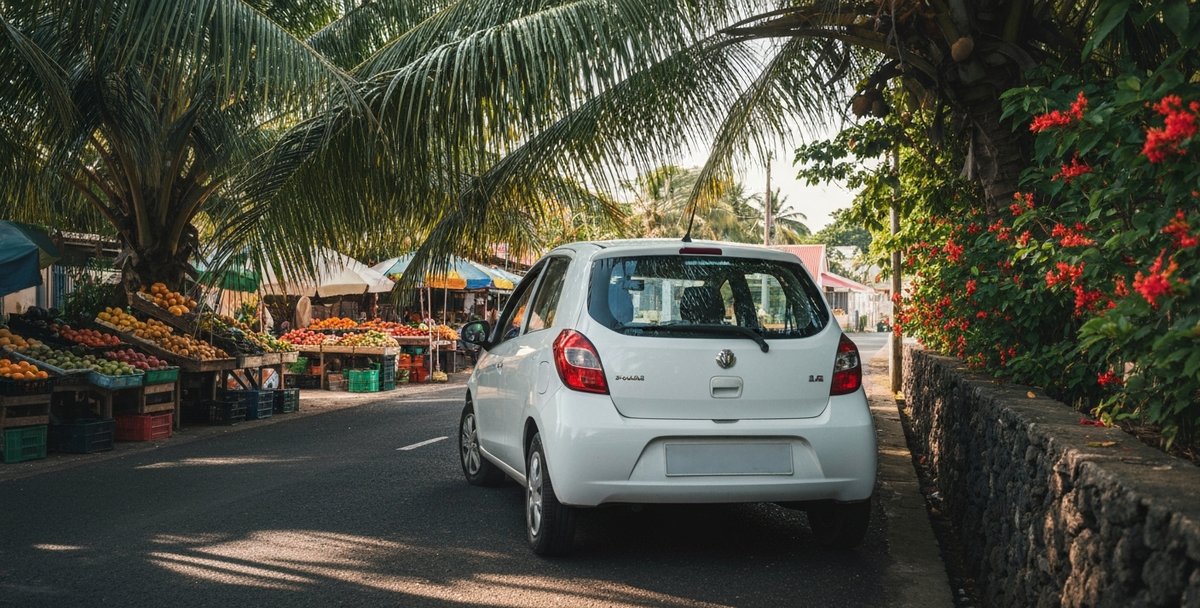
Pre-booked private transfers occupy the space between taxis (which you find on the day) and car hire (which requires you to drive yourself). You agree on the route and price in advance, a verified driver arrives at the agreed time, and you are taken door-to-door without negotiation or surprises.
This model works particularly well for:
- Airport arrivals when you have luggage and do not know the island
- Multi-stop itineraries covering several attractions in one day
- Groups of three or more, where the per-person cost becomes competitive with taxis
- Night travel, when finding an on-street taxi can be difficult
- Families with children in car seats (you can specify requirements in advance)
Mauritian Rides operates exactly this model — drivers are verified, prices are shown upfront before you confirm the booking, and you pay digitally. For visitors who want to move around the island without the hassle of negotiating at each stop, it is the most convenient option currently available in Mauritius.
What Private Transfers Typically Cost
Pre-booked private transfers are usually priced similarly to negotiated taxi rates, but without the uncertainty. You are paying for certainty as much as the kilometre rate. On the platform, you will typically see prices that fall within the taxi range shown in the table above, sometimes slightly lower for longer routes because the driver is guaranteed the job in advance.
Getting from the Airport
Sir Seewoosagur Ramgoolam International Airport (SSR) sits in the south-east of the island, near Mahébourg. This geographic position is worth noting: if your hotel is in the north (Grand Baie, Trou aux Biches) or the west (Flic en Flac, Le Morne), the airport is roughly 50–60 km away, which is a 50–70 minute drive in normal traffic.
Your Options from the Airport
Official airport taxis operate from a desk inside the arrivals hall. Prices are fixed by zone and displayed on a board. This is the safest on-the-day option — no haggling, the rates are regulated — though they are generally at the higher end of the range.
Pre-booked private transfers through a service like Mauritian Rides are typically more convenient: you can arrange the pickup before you travel, the driver tracks your flight, and you avoid queuing at the taxi desk after a long-haul flight. For a detailed breakdown of airport options, see our guide to Mauritius airport transfers.
Public bus from the airport exists — there is a stop on the road outside arrivals — but with luggage and after a long flight it is rarely practical. The service also does not run late at night.
Car hire desks operate inside the terminal from all major companies. If you plan to hire throughout your stay, collecting at the airport makes sense.
Travelling Between the Main Regions
North Mauritius (Grand Baie, Trou aux Biches, Pereybère)
The north coast is the most tourist-dense part of the island and has the best concentration of taxis, restaurants, and activity operators. Getting around within the north — beach to beach, restaurant to bar — is easy with short taxi rides or, for those who are comfortable on two wheels, scooter hire (widely available locally, typically Rs 500–800 per day).
From the north to Port Louis is roughly 20–25 km along the M2 motorway — about 30 minutes without traffic, longer during morning and evening rush hours.
West Mauritius (Flic en Flac, Tamarin, Le Morne)
The west coast stretches about 35 km from Albion in the north down to Le Morne peninsula. The scenery is dramatic — the Rempart mountain range runs parallel to the coast — and the beaches are excellent. Public bus connections exist along the west coast road, but the frequency is lower than on the north-coast route. For visiting both Chamarel (inland) and Le Morne (coast) in one day, a private driver or hire car makes significantly more sense than attempting the bus.
South Mauritius (Souillac, Blue Bay, Mahébourg)
The south is less developed for tourism, which is precisely its appeal — the scenery at Gris Gris, the lagoon at Blue Bay, and the history around Mahébourg are all excellent. The bus network reaches all the main towns, but the timetables are less forgiving. A car or private driver is the most practical way to do a south coast day trip if you are based in the north or west.
East Mauritius (Belle Mare, Palmar, Île aux Cerfs)
The east coast has some of the most beautiful beaches on the island, including the long white stretch at Belle Mare. The roads are good, but the east is far from the airport and far from the north-coast tourist strip — roughly 45–60 km from Grand Baie. If you are not based on the east coast, getting there requires either a hire car or a transfer. The motorway network connects well to the east via the M2/A2.
Port Louis
The capital deserves its own note on transport. Driving into Port Louis during peak hours (07:00–09:00 and 16:30–18:30) can mean significant congestion around the La Tour Koenig and Plaine Lauzun areas. If you are visiting the waterfront, the central market, or Caudan Waterfront, consider taking a taxi in and out rather than driving yourself. Parking is available but limited, and navigating the city centre one-way system is confusing the first time.
Tips for Getting Around Safely at Night
After dark, transport in Mauritius works differently to daytime. The bus network stops running by around 20:00 at most, and in many areas earlier. On-street taxis are harder to find outside tourist zones, and ridesharing in the international sense (Uber, Bolt) does not operate here.
A few practical points for evening and night travel:
- Book your return transport before going out, not on the way home. If you are at a restaurant in Chamarel or a beach bar in Tamarin, confirm your driver before the evening starts.
- Hotel concierge desks can usually arrange a taxi for the evening, though prices may be marked up. Compare against booking directly through a platform.
- Travelling between the main tourist zones (Grand Baie, Flic en Flac, the hotel strips) by pre-booked car is comfortable and well-established — it is not an unusual request.
- Night transfers after late flights or early morning departures are a core use case for services like Mauritian Rides, where you can confirm your 03:00 pickup weeks in advance without relying on finding someone on the day.
For a fuller look at evening transport, see our guide to transport safety at night in Mauritius.
FAQ
What is the cheapest way to get around Mauritius?
The public bus is by far the cheapest option, with fares typically between Rs 15 and Rs 55 depending on distance. For visitors with time and flexibility, it is perfectly viable for travelling between major towns. The limitations are frequency (especially in the south and east), stopping times (mostly finished by 20:00), and the difficulty of reaching off-road attractions.
Do taxis in Mauritius use meters?
They are legally required to, though many tourist-route drivers prefer to quote a flat fare upfront. Both approaches are acceptable. If you are unsure whether a quoted flat rate is fair, ask your hotel or check the approximate ranges above before negotiating. On-meter fares are generally honest, and the NTA (National Transport Authority) does regulate the rates.
Can I use Uber in Mauritius?
No. As of 2026, Uber does not operate in Mauritius. The local equivalent — offering pre-booking, upfront pricing, and verified drivers — is platforms like Mauritian Rides, which was built specifically for the Mauritian market.
Is it safe to drive in Mauritius as a tourist?
Yes, for most visitors. Mauritius drives on the left, road signs are in English and French, and the main roads are in good condition. The biggest challenges are traffic congestion around Port Louis and potholes on secondary rural roads. International driving licences are accepted. If you are uncomfortable driving in a new country or have a tightly packed one-day itinerary, a private driver is a stress-free alternative.
How long does it take to get from the airport to Grand Baie?
Sir Seewoosagur Ramgoolam Airport is in the south-east; Grand Baie is in the far north. The distance is approximately 55–60 km and takes around 55–75 minutes depending on traffic. It is one of the longer airport-to-accommodation transfers on the island, so having a pre-booked driver waiting is particularly worthwhile.
Is car hire cheaper than taxis for a week in Mauritius?
For most visitors staying a week and exploring the island, yes. A week of car hire might cost Rs 10,000–18,000 depending on the vehicle, versus multiple daily taxis that could easily reach Rs 3,000–5,000 per day for multi-stop days. The break-even point is roughly three to four days of active exploration. If you are mostly staying at your hotel or resort with occasional short trips, taxis or pre-booked transfers may actually be more economical.